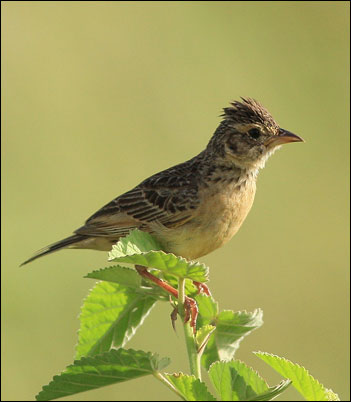
These are found from the Eyre Peninsula, South Australia, through Victoria, New South Wales, Queensland, Northern Territory and Western Australia to Shark Bay but are vagrant in Tasmania. Global distribution is from Nigeria to Arabia, India and the Malay Archipelago. Preferred habitat is tropical and temperate grasslands, open woodlands, cereal crops and sparse sugar cane fields.
They are mainly found on the ground and run without bobbing, this and its’ smaller size distinguish it from the Australasian Pipit. If disturbed, it may fly low to the ground in short jerky swoops, with the neck stretched so that the head is held up and the tail is pointed down. The Singing Bushlark is also known as the Horsfield's, Australasian or Brown Bushlark.
They feed on grasses, seeds and insects. It often forages alone, but sometimes is found in small parties, foraging on the ground.
The sexes are similar and the breeding season is between September and January but also follows significant rainfall in arid areas. They build a deep, cup-shaped nest in a natural depression or a hollow scrape in the ground which is usually lined with dry grasses, a hood of dry grasses is sometimes built over the nest.