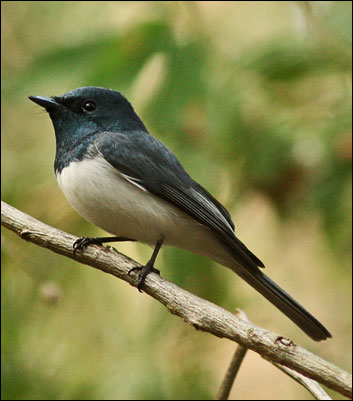
These arefound across northern Australia and down the east coast of Australia from the Kimberley region, Western Australia to eastern Victoria, they are also found in New Guinea and nearby islands. They are seasonal migrants and can occur virtually anywhere in the brief periods they are on the move, usually in March and September. In southern latitudes they usually arrive in September and the same territories are re-occupied year after year whereas in northern Australia they are regarded as sedentary.
Their habitat is tall and medium open woodlands, mainly in coastal areas, where insects caught on the wing or gleaned from foliage. They feed in the mid-canopy, darting from tree to tree in pairs or alone, perching only briefly on exposed twigs where they call and fan their short crests.
The photo is of a male; females have a blue-grey head and back with a distinctive reddish orange chin, throat and breast merging gradually into white lower parts. They build a shallow, cup-shaped nest of bark and grass held together by spider web and decorated with bark and lichen, both sexes build the nest, incubate the eggs and feed the young.