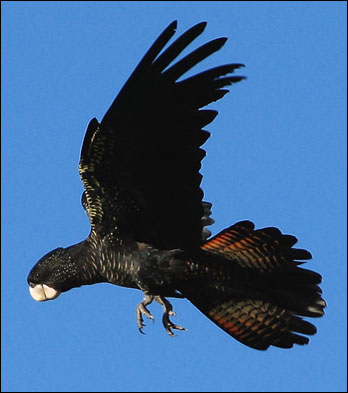
Red-tailed Black CockatooCalyptorhynchus banksii Average size 60cm
These large birds are widespread and abundant across much of northern and western Australia and in parts of N.S.W. and western Victoria, although in the last two areas they are less common and under threat through habitat destruction. On the Capricorn Coast they are quite commonly seen feeding in parks along our beaches, in fact they have become such a feature here that it has been suggested we adopt them as our Avian icon. They are seed eaters feeding on a broad range of native trees such as Eucalypts, Casuarinas and Banksias, here their favourites seem to be Pines, She-oaks and Beach Almonds.
Males are completely black in colour with prominent red bands across the tail while female and immature birds have yellow spots on the head, neck and wings, yellowish bars across the chest and a paler red band across the tail. Females are brownish black with yellow-orange stripes in the tail and chest and yellow spots on the cheeks and wings. Juveniles resemble females until puberty but have paler yellow barred underparts, as the birds reach maturity males gradually replace their yellow tail feathers with red ones; the complete process takes around four years.
Breeding generally occurs from May to September with nesting taking place in large vertical hollows in tall trees, isolated trees are generally chosen so birds can fly to and from them relatively unhindered, the same tree may be used for many years.
This is No 10 in a series
of articles on local birds that I'm writing for the Capricorn Coast Mirror, to see the list of articles so far published follow the link below.