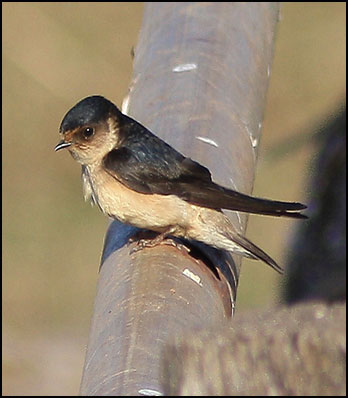
This member of the swallow family is found throughout most of Australia, New Guinea, Indonesia and the Solomon Islands. Swallows and martins are characterised by their adaptation to aerial feeding, with the name "martin" being used for the squarer-tailed species and the name "swallow" for the fork-tailed species; however there is no scientific distinction between the two groups.
Their preferred habitat is open woodland with large trees to provide nest holes but they have become increasingly common in urban and suburban areas, here you can find them along Hedlow Creek near Lake Mary.
They have a fast twisting flight and are frequently seen above tall eucalyptus trees catching insects above the canopy, they will also feed on insect swarms low over water. The sexes are similar and breed from July through to January, either in pairs or semi-colonially depending on nest site availability. Nests are made from grass and leaves reinforced with mud and with mud and plant fibre cement used to reduce the width of the entrance to the breeding hole. These are constructed in natural holes in dead trees or rock crevices, but increasingly in artificial sites on bridges and buildings.