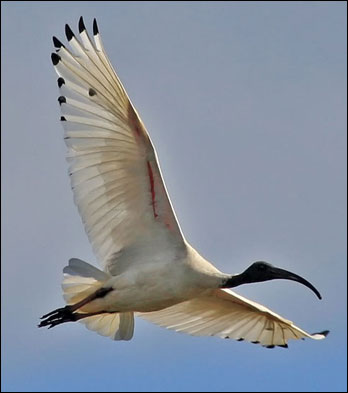
These are easily identified by their almost entirely white body plumage and black head and neck, they are common and widespread in northern and eastern Australia in habitats such as swamps, lagoons, floodplains and grasslands, but it has also become a successful inhabitant of urban parks and gardens and can be seen almost every day feeding in small groups throughout our area.
The long curved bill is used to probe for its food, which includes a wide range of terrestrial and aquatic invertebrates such as grubs, insects, shellfish and frogs.
Breeding season varies with the location within Australia, generally August to November in the south, and February to May, after the Wet Season, in the north. The nest is a shallow dish-shaped platform of sticks, grasses or reeds, located in trees and generally near a body of water such as river, swamp or lake. During the breeding season the small patch of skin you can see on the under-surface of the wing changes from dull pink to dark scarlet.
Our white Ibis is closely related to the Sacred White Ibis of Africa, which was venerated and often mummified by Ancient Egyptians as a symbol of the god Thoth who was associated with the arbitration of godly disputes, the arts of magic, the system of writing, the development of science, and the judgment of the dead. |